Strong Trolley Trend in Southern Cities
Four cities either are inaugurating, reviving or extending their streetcar lines this year, bringing to 25 the number of metro areas in North America that are keeping alive the early 20th-century approach to mass transit.
Among the latest places to hop on board:
+ Charlotte. On June 28, the city opened an extension of its trolley line to provide daily service from the historic South End neighborhood to the new Convention Center and the city's center. This fall, three vintage replica cars will be added to the fleet, which now consists of one restored car from 1927.
+ New Orleans. After a 40-year absence, streetcar service was restored to Canal Street in April. The line runs the length of the street along the edge of the French Quarter and includes a spur to the New Orleans Museum of Art in City Park. Unlike the cars on the famous St. Charles Streetcar Named Desire line, the Canal Street cars are air-conditioned and handicapped-accessible.
+ Memphis. In March, the city opened a 2-mile extension to its downtown trolley loop that runs along Madison Avenue and serves the new FedEx Forum.
+ Little Rock. The city gets its first streetcar line in early October, the 2.5-mile River Rail route that crosses the Arkansas River and connects the city with North Little Rock. Stops for tourists include the River Market entertainment district, Alltel Arena and the Statehouse Convention Center. Late next year, the line will be extended to the new William Jefferson Clinton Library.
Read the complete article here...
Sunday, January 02, 2005


Monday, November 08, 2004
"Commuting by automobile now takes so long that many workers have no time to do any actual work. When they reach their place of employment, they grab a cup of coffee, spend a few minutes discussing the previous night's episode of 'The Apprentice' with their co-workers, and immediately start the long commute home, unaware that their jobs were outsourced to Asia months ago."
-- Dave Barry
-- Dave Barry
Friday, November 05, 2004
RED OR BLUE RALLYING POINT: RELIEF FROM GRIDLOCK
In cities and suburbs — small, large, red and blue — voters were united this week on one key issue: paying to get out of traffic jams. They approved almost 80% of transportation tax and bond measures.
At least 23 of 31 ballot measures to launch or expand bus and rail lines in 11 states were approved. The price tag: more than $40 billion.
"It speaks volumes to what voters see as a very important problem," says Matt Jeanneret, spokesman for the transportation lobbying group. "People are clamoring for relief from traffic congestion. ... The voters are way ahead of the politicians on this."
Read more...
In cities and suburbs — small, large, red and blue — voters were united this week on one key issue: paying to get out of traffic jams. They approved almost 80% of transportation tax and bond measures.
At least 23 of 31 ballot measures to launch or expand bus and rail lines in 11 states were approved. The price tag: more than $40 billion.
"It speaks volumes to what voters see as a very important problem," says Matt Jeanneret, spokesman for the transportation lobbying group. "People are clamoring for relief from traffic congestion. ... The voters are way ahead of the politicians on this."
Read more...
Thursday, October 28, 2004
SILVER COMET TRAIL A MAGNET FOR DEVELOPMENT
Builders are filling empty lots or redeveloping land by the trail with new subdivisions. Sidewalks from the neighborhoods link directly to the trail. And entire towns — such as Powder Springs and Rockmart — that grew up along the old train track a century and more ago are beginning to see signs of renaissance, which they attribute in part to the Silver Comet. Powder Springs recently approved two new trailside subdivisions and is building its own trail, the Lucille Creek II Trail, which will connect 1,100 established homes to it.
Read more...
Builders are filling empty lots or redeveloping land by the trail with new subdivisions. Sidewalks from the neighborhoods link directly to the trail. And entire towns — such as Powder Springs and Rockmart — that grew up along the old train track a century and more ago are beginning to see signs of renaissance, which they attribute in part to the Silver Comet. Powder Springs recently approved two new trailside subdivisions and is building its own trail, the Lucille Creek II Trail, which will connect 1,100 established homes to it.
Read more...
Tuesday, October 26, 2004
A TREND TOWARD TRANSIT-ORIENTED TOWNHOMES
A study by Reconnecting America’s Center for Transit Oriented Development shows that demand for compact housing near transit is likely to more than double by 2025.
Hidden in Plain Sight: Capturing the Demand for Housing Near Transit finds that across the U.S. more than 14.6 million households are likely to want to rent and buy housing near transit by 2025, double the number that live in these neighborhoods today. Meeting this demand would require building 2,100 residential units near each of the 3,971 stations included in the study.
Read more...
A study by Reconnecting America’s Center for Transit Oriented Development shows that demand for compact housing near transit is likely to more than double by 2025.
Hidden in Plain Sight: Capturing the Demand for Housing Near Transit finds that across the U.S. more than 14.6 million households are likely to want to rent and buy housing near transit by 2025, double the number that live in these neighborhoods today. Meeting this demand would require building 2,100 residential units near each of the 3,971 stations included in the study.
Read more...
Saturday, October 23, 2004
BELTLINE RAIL ESTATE PURCHASE #1
Legendary Gwinnett County developer Wayne Mason is buying a choice corridor of kudzu-covered rail track that runs through the residential heart of Atlanta — a rusty line the city wants to revive as a transit system.
Mason is under contract to pay Norfolk Southern Corp. $25 million for the 4.6-mile rail artery running from DeKalb Avenue to Piedmont Park to I-85. The elongated strip of land amounts to about 67 acres.
The property is a key section of the Belt Line, a dormant, 22-mile railroad loop that Atlanta officials want to use as a transit path joining the city's historic neighborhoods and landmarks. The $679 million system would connect to several MARTA stations and move people from the Carter Center to Piedmont Park to the West End.
Source: ajc.com
Legendary Gwinnett County developer Wayne Mason is buying a choice corridor of kudzu-covered rail track that runs through the residential heart of Atlanta — a rusty line the city wants to revive as a transit system.
Mason is under contract to pay Norfolk Southern Corp. $25 million for the 4.6-mile rail artery running from DeKalb Avenue to Piedmont Park to I-85. The elongated strip of land amounts to about 67 acres.
The property is a key section of the Belt Line, a dormant, 22-mile railroad loop that Atlanta officials want to use as a transit path joining the city's historic neighborhoods and landmarks. The $679 million system would connect to several MARTA stations and move people from the Carter Center to Piedmont Park to the West End.
Source: ajc.com
Tuesday, October 12, 2004
NORCROSS SCHOOLS CELEBRATE WALK/BIKE TO SCHOOL DAY
According to a Sept. 7th Gwinnett Daily Post article, "About 600 students from Simpson Elementary ditched the bus Wednesday in favor of their feet. Simpson was one of several schools nationwide to participate in International Walk and Bike to School Day, an event designed to promote health, safety, physical activity and environmental concern. The streets surrounding Simpson were packed with students, parents and dogs who say the day gives them a chance to bond and enjoy the morning air. Kim Tardy walked with her daughter Bailey, and 8-year-old third-grader. She said Bailey normally rides the bus, but the family made special arrangements to take the two-mile trek from their home.
"'It's a community thing, and it's a healthy thing,' Tardy said. 'It teaches our kids that we are involved in what they are doing.' Walk to School Day was established in the United States in 1997 by the Partnership for a Walkable America. It is Simpson's fourth time participating, said PTA representative Lynn Grove. 'It's a very tight community and this is another way for us to get out say 'Hi' and have fun with our kids,' she said. Elizabeth Friedman walked her daughter Lauren, 10, to school at about 8:30 a.m. She said a lot of parents park their cars in nearby neighborhoods and finish the walk, but she and her daughter made the two-mile trip from their house on foot..."
Source: www.gwinnettdailyonline.com
According to a Sept. 7th Gwinnett Daily Post article, "About 600 students from Simpson Elementary ditched the bus Wednesday in favor of their feet. Simpson was one of several schools nationwide to participate in International Walk and Bike to School Day, an event designed to promote health, safety, physical activity and environmental concern. The streets surrounding Simpson were packed with students, parents and dogs who say the day gives them a chance to bond and enjoy the morning air. Kim Tardy walked with her daughter Bailey, and 8-year-old third-grader. She said Bailey normally rides the bus, but the family made special arrangements to take the two-mile trek from their home.
"'It's a community thing, and it's a healthy thing,' Tardy said. 'It teaches our kids that we are involved in what they are doing.' Walk to School Day was established in the United States in 1997 by the Partnership for a Walkable America. It is Simpson's fourth time participating, said PTA representative Lynn Grove. 'It's a very tight community and this is another way for us to get out say 'Hi' and have fun with our kids,' she said. Elizabeth Friedman walked her daughter Lauren, 10, to school at about 8:30 a.m. She said a lot of parents park their cars in nearby neighborhoods and finish the walk, but she and her daughter made the two-mile trip from their house on foot..."
Source: www.gwinnettdailyonline.com
Monday, September 20, 2004
MARTA holding public meetings to gather input on the BeltLine and C-Loop
MARTA is holding four public meetings to gather input on the Belt Line and C-Loop, mass transit proposals for the city of Atlanta and DeKalb County. The Belt Line is a 22-mile ring of train tracks circling Atlanta, where a street car or trolley could run. The C-Loop is a rail route connecting Emory University, downtown Atlanta and the Atlanta University Center. Two meetings this week are:
• 6-8 p.m. Tuesday at Antioch Baptist Church, 540 Kennedy St. N.W., Atlanta. Call 404-688-5679 for more information.
• 4-6 p.m. Wednesday at Emory University's Rollins School of Public Health, 1518 Clifton Road, Atlanta. Call 404-727-5166 for more information.
MARTA is holding four public meetings to gather input on the Belt Line and C-Loop, mass transit proposals for the city of Atlanta and DeKalb County. The Belt Line is a 22-mile ring of train tracks circling Atlanta, where a street car or trolley could run. The C-Loop is a rail route connecting Emory University, downtown Atlanta and the Atlanta University Center. Two meetings this week are:
• 6-8 p.m. Tuesday at Antioch Baptist Church, 540 Kennedy St. N.W., Atlanta. Call 404-688-5679 for more information.
• 4-6 p.m. Wednesday at Emory University's Rollins School of Public Health, 1518 Clifton Road, Atlanta. Call 404-727-5166 for more information.
Thursday, September 16, 2004
The BeltLine: "mass transit darling of the region's 25-year transportation plan."
It came out on top in a 2003 study of possible transit routes, beating out bus lanes on I-285, commuter train service to Gainesville, and any new MARTA train line. Now the region is ready to invest over $680 million in the Belt Line and another intown transit route called the C-Loop because it forms a "C" linking Emory University, Lindbergh Center, downtown Atlanta and the Gallery at South DeKalb, formerly South DeKalb Mall.
Read more...
It came out on top in a 2003 study of possible transit routes, beating out bus lanes on I-285, commuter train service to Gainesville, and any new MARTA train line. Now the region is ready to invest over $680 million in the Belt Line and another intown transit route called the C-Loop because it forms a "C" linking Emory University, Lindbergh Center, downtown Atlanta and the Gallery at South DeKalb, formerly South DeKalb Mall.
Read more...
Monday, September 13, 2004
Thursday, September 02, 2004
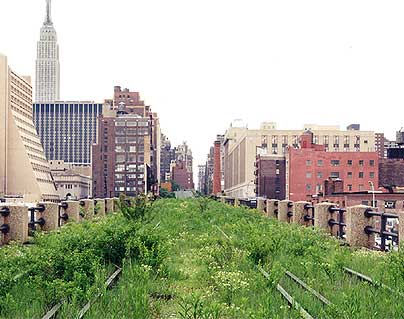
The Vision for NYC's High Line:
When the High Line is converted to public open space, you will be able to rise up from the streets and step into a place apart, tranquil and green. You will see the Hudson River, the Manhattan skyline, and secret gardens inside city blocks as you've never seen them before. You will move between Penn Station and the Hudson River Park, from the convention center to the Gansevoort Market Historic District, without meeting a car or truck. The High Line will be a promenade—a linear public place where you will see and be seen. You will sense New York's industrial past in the rivets and girders. You will perceive the future unrolling before you in an artfully designed environment of unprecedented innovation. It will be yours—public in the truest sense of the word. Public dollars helped build it in the 1930s. Public legislation empowers us to make it a place anyone can visit. It will be proof New York City no longer casts aside its priceless transportation infrastructure but instead creates bold new uses for these monuments to human power and ambition.*
The Vision for Atlanta's BeltLine:
Now imagine this same scenario in Atlanta encompassing 22 miles instead of 2.5!
*Source: Friends of the High Line
When the High Line is converted to public open space, you will be able to rise up from the streets and step into a place apart, tranquil and green. You will see the Hudson River, the Manhattan skyline, and secret gardens inside city blocks as you've never seen them before. You will move between Penn Station and the Hudson River Park, from the convention center to the Gansevoort Market Historic District, without meeting a car or truck. The High Line will be a promenade—a linear public place where you will see and be seen. You will sense New York's industrial past in the rivets and girders. You will perceive the future unrolling before you in an artfully designed environment of unprecedented innovation. It will be yours—public in the truest sense of the word. Public dollars helped build it in the 1930s. Public legislation empowers us to make it a place anyone can visit. It will be proof New York City no longer casts aside its priceless transportation infrastructure but instead creates bold new uses for these monuments to human power and ambition.*
The Vision for Atlanta's BeltLine:
Now imagine this same scenario in Atlanta encompassing 22 miles instead of 2.5!
*Source: Friends of the High Line
Wednesday, September 01, 2004
Tuesday, August 31, 2004
The ultimate lean, green, clean machine

Bamboo Bicycle
I am riding a bamboo bicycle through the main street of Christiania. Usually it takes quite a bit to make the roughies turn their heads - but this bamboo bicycle does the trick. It is beautiful, light and fast - and it is nice to touch. As I park the bamboo bicycle in front of the Shop in order to have a black currant juice it feels almost as if I am dismounting a Harley right next to a café - several people come over to touch the frame and to check out how the bike is made. "Where have you got that from?” they ask, here in the Paradise of Bicycles, the almost car-free town in the middle of Copenhagen. So where have I got it from? - Well, from The Smithy next to The Grey Hall. The Smithy of Christiania has for the last 30 years been a furnace of innovation on the bicycle front. First came the Dursly-Pedersen bicycle whose rider feels like he is in a camels saddle. Then came the bicycle trailer, which became car free families way of transporting groceries on holidays and on weekdays, and at the moment The Smithy sells carrier bicycles for the transportation of children and many an odd purpose. And now the bamboo bicycle is being introduced. Flavio Deslandes is the man behind the development of a bicycle made of bamboo. He is Brazilian and he is an industrial designer from the PUC-Rio University. I met him in his small workshop next to The Smithy. The bicycle is one of the worlds most brilliant inventions. It is hard to find a disadvantage (to the bicycle) - except the material it is made from. Light bicycles are made from aluminum, which is one of the most resource demanding materials that exist. My bicycles are made of grass, he says. I scan my own knowledge and experience with bamboo. Let’s skip the cane and the flower sticks - what else is there? Garden furniture and squeaky armchairs. It is hard to find anything particularly brilliant about that material. But Flavio makes me see things differently: Bamboo is a resource of immense potential. And it is strong too. What makes it possible to build bicycles from it is that it is stronger than steel when strained in the longitudinal direction, 17% to be exact. I can stuff my thoughts about squeaky furniture. History teaches us that it was bamboo Faber glowing in Edisons first electric bulb and that it was bamboo that kept the very first airplanes in Paris, constructed by Santos Dumont, together. Bamboo is beneficial to the CO2 value of the atmosphere. While growing it emits more oxygen that the equivalent amount of wood pulp. So please caress your bamboo bicycle gently while you marvel at the thought that bamboo keeps more that two billion people around the world employed, that it grows without fertilizer and that it can be used for almost everything - from tasty rice dishes to building material. Bamboo is a species of grass and every third year it can be harvested. It needs no replanting and it comes in sizes from small to extra large literally speaking: The biggest ones grow up to 60 meters tall. While Flavio turns on the computer he tells me a couple of more facts about bamboo. The first thing flowering in Hiroshima after that the bomb had destroyed everything was - take a guess. The only building still standing after the earth quake in Costa Rica in 1992 was - yes, that is the correct answer. Flavio searches in his CAD program and comes up with a wheel. Not that he invented it but he looks just like he did when he looks up at me with sparks in his jet black eyes. "This is going to be a revolution: the bicycle wheel made out of bamboo. There is steel in the assemblies of my bicycles. But unlike everything else that is made out of bamboo - for instance the furniture that you talked about - the steel used here serves the bamboo, not the other way around. I use bamboo in its natural form in the bicycle. If you start bending it, drilling holes in it or you put nails or spikes into it you’ll weaken the structure,” he says. He shows me how every part of the frame is fitted into the assembling and kept in place with glue. "But I keep on researching in order to find even more replacements for the metal parts. This wheel here is one hundred percent bamboo: Rims and hub are made out of laminated bamboo and the spokes are made out of straight bamboo sticks. I also work on being able to produce pedals and pedal arms in bamboo,” Flavio says proudly. "Building these bicycles is art. It is not something you just do. Every bamboo must be selected and fitted into the frame according to size and quality. The secret lies in treating and handling the material the right way. Learning that takes times and the maintenance takes time as well. Just like it takes time to learn how to play football,” Flavio Deslandes says and smiles Brazilianly.
by Steen Heinsen
Source: American Bamboo Society
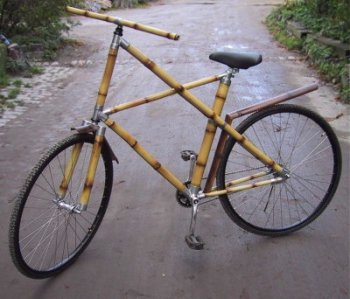
Bamboo Bicycle
I am riding a bamboo bicycle through the main street of Christiania. Usually it takes quite a bit to make the roughies turn their heads - but this bamboo bicycle does the trick. It is beautiful, light and fast - and it is nice to touch. As I park the bamboo bicycle in front of the Shop in order to have a black currant juice it feels almost as if I am dismounting a Harley right next to a café - several people come over to touch the frame and to check out how the bike is made. "Where have you got that from?” they ask, here in the Paradise of Bicycles, the almost car-free town in the middle of Copenhagen. So where have I got it from? - Well, from The Smithy next to The Grey Hall. The Smithy of Christiania has for the last 30 years been a furnace of innovation on the bicycle front. First came the Dursly-Pedersen bicycle whose rider feels like he is in a camels saddle. Then came the bicycle trailer, which became car free families way of transporting groceries on holidays and on weekdays, and at the moment The Smithy sells carrier bicycles for the transportation of children and many an odd purpose. And now the bamboo bicycle is being introduced. Flavio Deslandes is the man behind the development of a bicycle made of bamboo. He is Brazilian and he is an industrial designer from the PUC-Rio University. I met him in his small workshop next to The Smithy. The bicycle is one of the worlds most brilliant inventions. It is hard to find a disadvantage (to the bicycle) - except the material it is made from. Light bicycles are made from aluminum, which is one of the most resource demanding materials that exist. My bicycles are made of grass, he says. I scan my own knowledge and experience with bamboo. Let’s skip the cane and the flower sticks - what else is there? Garden furniture and squeaky armchairs. It is hard to find anything particularly brilliant about that material. But Flavio makes me see things differently: Bamboo is a resource of immense potential. And it is strong too. What makes it possible to build bicycles from it is that it is stronger than steel when strained in the longitudinal direction, 17% to be exact. I can stuff my thoughts about squeaky furniture. History teaches us that it was bamboo Faber glowing in Edisons first electric bulb and that it was bamboo that kept the very first airplanes in Paris, constructed by Santos Dumont, together. Bamboo is beneficial to the CO2 value of the atmosphere. While growing it emits more oxygen that the equivalent amount of wood pulp. So please caress your bamboo bicycle gently while you marvel at the thought that bamboo keeps more that two billion people around the world employed, that it grows without fertilizer and that it can be used for almost everything - from tasty rice dishes to building material. Bamboo is a species of grass and every third year it can be harvested. It needs no replanting and it comes in sizes from small to extra large literally speaking: The biggest ones grow up to 60 meters tall. While Flavio turns on the computer he tells me a couple of more facts about bamboo. The first thing flowering in Hiroshima after that the bomb had destroyed everything was - take a guess. The only building still standing after the earth quake in Costa Rica in 1992 was - yes, that is the correct answer. Flavio searches in his CAD program and comes up with a wheel. Not that he invented it but he looks just like he did when he looks up at me with sparks in his jet black eyes. "This is going to be a revolution: the bicycle wheel made out of bamboo. There is steel in the assemblies of my bicycles. But unlike everything else that is made out of bamboo - for instance the furniture that you talked about - the steel used here serves the bamboo, not the other way around. I use bamboo in its natural form in the bicycle. If you start bending it, drilling holes in it or you put nails or spikes into it you’ll weaken the structure,” he says. He shows me how every part of the frame is fitted into the assembling and kept in place with glue. "But I keep on researching in order to find even more replacements for the metal parts. This wheel here is one hundred percent bamboo: Rims and hub are made out of laminated bamboo and the spokes are made out of straight bamboo sticks. I also work on being able to produce pedals and pedal arms in bamboo,” Flavio says proudly. "Building these bicycles is art. It is not something you just do. Every bamboo must be selected and fitted into the frame according to size and quality. The secret lies in treating and handling the material the right way. Learning that takes times and the maintenance takes time as well. Just like it takes time to learn how to play football,” Flavio Deslandes says and smiles Brazilianly.
by Steen Heinsen
Source: American Bamboo Society
Wednesday, August 25, 2004
San Francisco's "F" Line Streetcar: "Nobody goes there anymore. It's too crowded."
San Francisco has experienced overwhelming success with its newly-introduced F-Embarcadero streetcar line. It's four miles long and carries 20,000 passengers a day, more than twice the projections.
The San Francisco Chronicle reports the line is so popular it has surpassed ridership of all of the city's cable cars combined, and the city has ordered 11 more streetcars just to keep up with demand. They're also already looking at expanding to new lines.
They've supplemented the system with buses, but one local business leader says he saw a man refuse to board, saying he wanted a streetcar, not a bus.
Source: Atlanta Streetcar, Inc. Newsletter
Read the complete article here...
San Francisco has experienced overwhelming success with its newly-introduced F-Embarcadero streetcar line. It's four miles long and carries 20,000 passengers a day, more than twice the projections.
The San Francisco Chronicle reports the line is so popular it has surpassed ridership of all of the city's cable cars combined, and the city has ordered 11 more streetcars just to keep up with demand. They're also already looking at expanding to new lines.
They've supplemented the system with buses, but one local business leader says he saw a man refuse to board, saying he wanted a streetcar, not a bus.
Source: Atlanta Streetcar, Inc. Newsletter
Read the complete article here...
Monday, August 23, 2004
Britain's Strategic Rail Authority has announced the launch of "a major new awards scheme to recognise progress made by the rail industry towards encouraging the integrated use of bicycles and travel by train.
Expert judges will consider nominations in five categories: station of the year, best on-train experience, top customer service, most outstanding individual service and best integrated rail and cycling innovation."
Read the full story here.
Expert judges will consider nominations in five categories: station of the year, best on-train experience, top customer service, most outstanding individual service and best integrated rail and cycling innovation."
Read the full story here.
Tuesday, August 17, 2004
Yale planner Garvin to study Belt Line
Atlanta's Belt Line concept continues to pick up steam.
In the latest move, renowned Yale University planner Alexander Garvin has signed on to study the effort to redevelop a largely abandoned series of rail lines that surround downtown in a 22-mile loop. Garvin's goal is to identify areas near the Belt Line that could be turned into large parks.
Garvin, whose recent projects include the redevelopment of ground zero in New York City and that city's 2012 Olympics bid, has been hired by the Trust for Public Land, a national land conservation group.
James Langford, director of TPL's Georgia office, said a report from Garvin is expected before the end of the year. The Belt Line, conceived by former Georgia Tech student Ryan Gravel, may include a transit line as well as a path for bicycling and walking.
— Paul Donsky
Source: ajc.com>Ahead of the Curve
Atlanta's Belt Line concept continues to pick up steam.
In the latest move, renowned Yale University planner Alexander Garvin has signed on to study the effort to redevelop a largely abandoned series of rail lines that surround downtown in a 22-mile loop. Garvin's goal is to identify areas near the Belt Line that could be turned into large parks.
Garvin, whose recent projects include the redevelopment of ground zero in New York City and that city's 2012 Olympics bid, has been hired by the Trust for Public Land, a national land conservation group.
James Langford, director of TPL's Georgia office, said a report from Garvin is expected before the end of the year. The Belt Line, conceived by former Georgia Tech student Ryan Gravel, may include a transit line as well as a path for bicycling and walking.
— Paul Donsky
Source: ajc.com>Ahead of the Curve
Friday, August 13, 2004
TRACTION FOR SPINNING WHEELS
The Atlanta Regional Commission has recently concluded that the most effective transit initiative planned for construction in the next 25 years is the one known as the Belt Line/C-Loop. ARC officials are calling it the Inner Core Transit, a line that would include a parallel trail network and loop through many of Atlanta's intown neighborhoods, linking them to MARTA and each other.
"The Inner Core is an extremely important piece," said ARC Transportation Planning Director Jane Hayse.
Read more...
The Atlanta Regional Commission has recently concluded that the most effective transit initiative planned for construction in the next 25 years is the one known as the Belt Line/C-Loop. ARC officials are calling it the Inner Core Transit, a line that would include a parallel trail network and loop through many of Atlanta's intown neighborhoods, linking them to MARTA and each other.
"The Inner Core is an extremely important piece," said ARC Transportation Planning Director Jane Hayse.
Read more...
Tuesday, August 10, 2004
Atlanta Mayor Franklin vows to make "the multimodal station, the Belt Line, the Peachtree Streetcar... affordable housing, parks... accessibility, MARTA... air quality, traffic congestion" a good part of her primary focus during the remainder of her time in office.
"Reinforcing her point, Franklin said the city wants a viable MARTA system, more development, more density and more parks. And just about everyone agrees that a strong region needs a healthy core."
Source: ajc.com>Business>Maria Saporta
"Reinforcing her point, Franklin said the city wants a viable MARTA system, more development, more density and more parks. And just about everyone agrees that a strong region needs a healthy core."
Source: ajc.com>Business>Maria Saporta
Monday, August 09, 2004
TPL Greenspace Study
The Trust for Public Land has tapped world-renowned park planner and greenspace advocate Alexander Garvin to do a greenspace study for the Belt Line. TPL is examining the Belt Line proposal as an opportunity to assist the City in acquiring appropriate tracts on which to develop parks and other recreational facilities along the old railroad corridors. In addition to the proposed linear park and trail, TPL wants to expand the 'emerald necklace' idea to include several new park 'jewels' around the 22-mile loop. "This is one of those rare opportunities that come along once in a lifetime," says TPL's Georgia State Director James Langford. "What we have here is a chance to have a dramatic effect not only on the volume but also on the quality of parks in Atlanta. We know the impact that something like the Belt Line is bound to have on the economic vitality of the city; and what it does for the economy, it can also do for Atlanta’s park system."
Source: Friends of the BeltLine Newsletter
The Trust for Public Land has tapped world-renowned park planner and greenspace advocate Alexander Garvin to do a greenspace study for the Belt Line. TPL is examining the Belt Line proposal as an opportunity to assist the City in acquiring appropriate tracts on which to develop parks and other recreational facilities along the old railroad corridors. In addition to the proposed linear park and trail, TPL wants to expand the 'emerald necklace' idea to include several new park 'jewels' around the 22-mile loop. "This is one of those rare opportunities that come along once in a lifetime," says TPL's Georgia State Director James Langford. "What we have here is a chance to have a dramatic effect not only on the volume but also on the quality of parks in Atlanta. We know the impact that something like the Belt Line is bound to have on the economic vitality of the city; and what it does for the economy, it can also do for Atlanta’s park system."
Source: Friends of the BeltLine Newsletter
Subscribe to:
Comments (Atom)