Friday, May 27, 2005

The Beltline Unbuckled


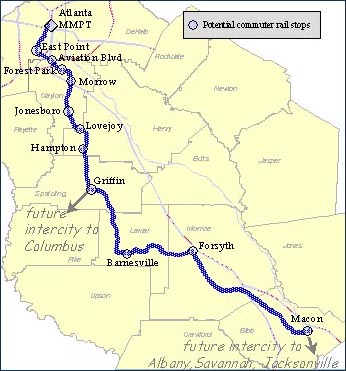
Atlanta to Macon SouthLine Rail Posted by Hello

THE BELTLINE UNBUCKLED: WHY THE SOUTHLINE FROM ATLANTA TO MACON IS JUST AS SIGNIFICANT AS THE INTOWN BELTLINE

By now many are familiar with the BeltLine, the 22 mile Intown trail and transit loop poised to transform the core of Atlanta. The BeltLine has gained amazing traction in the public and private realms this past year, and for good reason, with it's promise of community connectivity, brownfield redevelopment, and auto independence. James Langford, Director of the Trust for Public Land, Georgia says "the possibility that the old loop of railways could serve as a multiuse transit corridor with parks anchoring future redevelopment is an opportunity unmatched in America." [Source: ajc.com:: Bold Belt Line/park plan would break new ground].

Mr. Langford's statement should help us to envision the potential inherent in the coming Atlanta - Lovejoy Commuter Rail Line, slated to begin service in the Fall of 2006. Although originally intended to reach all the way to Macon while passing through several Southside cities, the Governor said the budget simply wouldn't allow for the $350 million (year 2003 dollars) price tag. However, a consortium of Mayors and Movers-and-Shakers from East Point, Forest Park, Morrow, Jonesboro, and LoveJoy, convinced that the rail should no longer be delayed, approached the Governor with an offer he couldn't refuse: They would commit portions of their local budgets to absorb any shortfall in revenues from ridership against operating expenses if he would simply commit the federal funds already allocated.

Although the available $106 million only reaches to LoveJoy, it's a start. Click here for a detailed GDOT report on this initiative.

From a budget stance, there should be no argument about taking the line all the way to Macon, when you consider that the total expenditure of $350 million gets us 103 miles of track, stations and rolling stock carrying 7200 trips a day versus just 9 miles of intown HOV with no significant relief in gridlock and a further decrease in air quality.

Equally compelling is the realization that, just as the BeltLine passes through such cherished landscape as Piedmont Park, Westview Cemetery, Ansley Golf Club, and Zoo Atlanta, the SouthLine passes through towns ripe with potential like Hampton, Barnesville, and Griffin. These towns were thriving centers of commerce when rail was relevant to their economies with many rail passengers making connections from their stations to points north and south on a daily basis. With it's built-in infrastructure as a rail-centric city, one can imagine a new Griffin rising, like the mythical bird, from the ashes of it's previous glory days with a new Intercity Rail Station and a strategic postion on a world class alternative transportion corridor. One can visualize Hampton residents able to walk or bike to and from the station without the use of their cars and a town better able to accommodate the huge influx of visitors to the Atlanta Motor Speedway every year. Just as significant as the highly touted brownfield redevelopment potential of land in proximity to the BeltLine, these towns possess acres and acres of resurrectable residential and retail opportunities within the pedestrian shed of their proposed station sites.

Most importantly, the SouthLine strand would connect 12 municipal "jewels", not only to Atlanta and each other, but to the BeltLine itself. While the BeltLine is a loop opportunity and the Southline is a linear opportunity, they are simply different expressions of the same solution. We would be so bold as to suggest the SouthLine and the BeltLine be seen as a single entity -- the BeltLine Unbuckled, if you will -- and viewed as a 125 mile alternative transportation venue. To view the SouthLine as only ferrying commuter traffic into Atlanta in the mornings and back in the evenings is, we believe, short-sighted. When you start to visualize intercity rail traffic throughout the day, then you begin to grasp the real potential of the SouthLine.

In addition, the opportunities for accommodating the coming population growth cannot be overemphasized. With the region speculated to grow in the millions within the next 20 years, progressive and creative governments and policy makers along the SouthLine have within their grasp an unprecedented mechanism for controlling the growth by employing Smart Growth principles around the rail nodes. By changing the local zoning and ordinances to accommodate mixed-use development and allow for transit villages to organically grow along the SouthLine, and by encouraging and incenting infill development around the rail nodes, we can hope to grow less chaotically and significantly reduce the effects of sprawl and traffic congestion, simply by giving a portion of the incoming population a choice not presently offered.

The reality is that passengers will travel the SouthLine long before any do the BeltLine. This work must begin now and in earnest in order to seize the opportunity. These towns cannot afford to be in denial about the fact that they are positioned to soon be swept into the ever expanding orbit of the fastest growing human settlement in the history of Planet Earth. With foresight, creativity, and passionate action, cities on the SouthLine can be the architects of opportunities unmatched in America.

Burke Sisco
Chairman
Trail + Rail Action Coalition [TRAC]
Hampton, Georgia
www.trailrail.org

Wednesday, May 25, 2005

"FORWARD TO THE PAST" - A VISION FOR HAMPTON'S FUTURE

The Vision

One of the most endearing elements of the Back to the Future film trilogy was the town of Hill Valley. Exciting stuff took place in the quaint town square with one of the buildings even playing a "starring" role (remember the courthouse with the clock tower?). A sense of nostalgia was created as the town remained relatively unchanged across historical nodes ranging from 1885 to 2015. We were entertained as we watched the favorite mode of urban transportation evolve from skateboards to futuristic hoverboards, while the backdrop of Hill Valley remained familiar and established, maintaining a sense of place; a place worth protecting and preserving. We rooted for Marty McFly as he employed the technology of time travel to move back and forth along the time line in order to thwart the evil Biff's greedy and self-serving efforts at transforming Hill Valley into a web of casinos and pleasure palaces.

Those popular movies provide us with the perfect metaphor for our vision and goals for Hampton, Georgia. "Forward to the Past" describes perfectly where we want to go. Sometimes progress means admitting that what we thought was progress was really moving in the wrong direction. Outlawing zoning that allowed for more compact, mixed-used neighborhoods and towns was a bad way to go. Disallowing a shop-keeper the right to live above her shop has deprived many of a practical and logical way to live and do business. Modern zoning and city planning has ushered in the age of the "Big Box" retail giants with scores of small towns dying in the process. Our communities have become so disconnected that children rarely walk or bike to school. The end result is urban sprawl, an unhealthy dependency on the automobile and oil consumption, alienation from our neighbors, and a loss of community. We can't say it any better than is already stated in Reconnecting America's Mission Statement. Our goal is to see Hampton embrace these proven concepts for smart growth as soon as possible.

You say you want a railvolution?

Our definition of New Urbanism is really just the old urbanism or sub-urbanism of livable villages or towns built around a railroad depot. A town built on a scale that allows its citizens to live within walking distance of the station and every other modern need or convenience that they might have. We combine the revolutions of New Urbanism and the national rail renaissance and see Hampton, which currently sits on the coming Atlanta-to-Macon Commuter Rail Line, evolve into a Transit Town of the 21st Century.

How about a velorution?

But we propose a third component that will truly make Hampton unique in metro Atlanta Transit-Oriented Towns (TOT): Weave into the fabric of the town a system of paths and trails that make the growing use of alternative transportation an easy option for the residents. Until hoverboards are available, your child could scooter to school, your spouse could bike to the bakery, and you could Segway to the Station or tool around town in a cycle car. We want to put Hampton at the crossroads of three synergistic American revolutions (New Urbanism, transit lines, and bicycle/pedestrian paths) and see a town develop that is the perfect and logical blending of these positive social movements.

HOT for TOT

This vision won't be realized without leadership. A newly formed group of Hampton citizens has formed a grass-roots political action group called H.O.T. (Hampton's Our Town). We've adopted the motto for Hampton, "The little town that CAN!". Our goal is to get wise and visionary officials elected to office that can help steer our village into a prosperous future while effectively managing the tsunami of growth soon to wash over us.

We believe we've got a setting in Hampton in which we can reverse the trend of unsustainable and undesirable growth in the metro Atlanta area and move in a new, and yet established and familiar direction.

Join us for the trip. We can't offer you transportation in a time-traveling DeLorean but with the right leadership and a lot of hard work, the city of Hampton can become a place that inspires people everywhere to return to classic elements of city planning and design that echo the quality-of-life of an earlier era and one that so many yearn for today.

And so, with anticipation and a sense of adventure, we say: "Forward to the Past".

Burke Sisco
404.421.9968
burke@burkesisco.com

Monday, May 23, 2005

"The Roman Emperor Hadrian insightfully observed: 'This luxury of speed destroys its own aim; a pedestrian makes more headway than a hundred conveyances jammed end-to-end along the twists and turns of the Sacred Way.' To the best of our knowledge, this stands as the first traffic report."

- Sean Hayes, "Autobiography: An Alternative History of the Car" in "Beyond the Car: Essays on the Auto Culture," 1995

Friday, May 20, 2005

59% of Georgians are obese, DHR study says

Atlanta (GA) – The Georgia Department of Human Resources (DHR) announced today the release of Overweight and Obesity in Georgia 2005, a report focusing on the health risks and costs of obesity. The report confirms what officials have known for years: Obesity is one of the top public health problems in Georgia.

According to the report, an estimated 6,700 Georgians die each year because they are overweight or obese. Overweight and obesity are associated with a number of conditions, including heart disease, stroke, diabetes, cancer, and osteoarthritis as well as depression, menstrual irregularities, and sleep apnea. Recent statistics indicate that 59% of adults in Georgia are overweight or obese.

Read more...

Monday, May 02, 2005

Binge on the BeltLine, the world class ATL Trail + Rail Initiative...

Source: stacks.ajc.com

Friday, April 29, 2005

DO THE MATH

For the $351 million it is expected to cost to have an Atlanta-Macon commuter rail line at a length of 103 miles, the state could build only 9.1 miles of HOV lanes or 18 miles of bus rapid transit.

Transportation/Land Use studies linking investment in new rail infrastructure to new development report that, on average, $6 is spent in new development for every $1 of rail investment. So the Atlanta-Macon commuter rail investment has the potential of spawning over 2 billion dollars in new development.

Friday, April 22, 2005

GEORGIA DOT WORKS ON BIKE PLANS WITH REGIONAL CENTERS

According to an April 20th Macon Telegraph editorial, "The carnival
atmosphere of the Tour de Georgia and its racers have come our way and
gone for another year. Gone, too, are the frenzied fans who will follow
the cyclists on to the finish in Rome. Left behind are an excited group
of amateur cyclists as well as a growing number of moms, dads and
children who would love to safely pedal their way to fun and health.
The problem is neither our urban or suburban streets are very bicycle
friendly. Without the safety nets provided by police escorts,
designated bike routes and stopped traffic that helped ensure the
safety of the professional riders, local cyclists are left to fend for
themselves on congested streets.

"The much-maligned Georgia Department of Transportation, most often a
whipping boy for a public weary of the ribbons of concrete continually
being widened or repaved, is now working with Regional Development
Centers to improve cycling conditions throughout the state. It is
requiring the centers to produce regional bicycle/pedestrian plans. The
mission is not only improved safety for cyclists, but also reducing
auto congestion and pollution and improving overall health by
encouraging walking and bicycling. The Middle Georgia plan, released in
December, starts with a detailed analysis of existing bicycle friendly
routes. It's a short list. As the plan notes, the Middle Georgia region
is 'littered with local bicycle/pedestrian plans that have not been
implemented.'..."

Source: http://www.macon.com/mld/macon/news/opinion/11435271.htm
Archive search: http://www.macon.com/mld/macon/archives/
Title: "Bicycle path planning a good starting point"
Author: Editorial board

Monday, April 04, 2005

Public Transportation Ridership Up By 2.11% In 2004
The American Public Transportation Association (APTA) announced that 9.6 billion trips were taken on U.S. local public transportation systems in 2004, an increase of 2.11 percent over the previous year. This growth rate was faster than highway vehicle travel, which grew by 1.14 percent in 2004. Read more about it here.

Saturday, March 12, 2005


Transect Planning Mural Posted by Hello
LOVEJOY RAIL PROJECT PRESENTS HUGE OPPORTUNITY FOR PROGRESSIVE PLANNING

The debate that rages over the Atlanta-Lovejoy commuter rail tends to camp on ridership. It's not just about that. As crucial to the discussion is counteracting the typical sprawl pattern of growth that Atlanta is famous for. To understand the ridership issue, you must foresee the hidden opportunities for sprawl control a commuter rail station presents in Lovejoy. With clear logic, we see the ridership and sprawl issues addressed simultaneously.

If you've been to Lovejoy, you know it's one of the most sparsely populated areas (for now) on the Southside.

Therein lies the beauty of it.

Lovejoy is wide open for a world-class transit village to be constructed around the train station. Build a mixed-use village with residential, retail, and business at appropriate densities with sufficient connectivity to the station, and they will come and these urban pioneers will ride.

Before the density-haters cry "foul", consider that through Transect Planning, the density around the train station would become progressively less dense as you move outward from the transit zone, perserving more true rural character than would be the case with the current zoning model. Add in Transfer of Development Rights, where land owners can be paid to not develop their land by "sending" the rights inside the transit zone, and you've got a recipe for Super Smart Growth on the Southside.

We cannot afford to be in denial about the coming population explosion and must plan for it accordingly, bringing to bear the best in planning practices.

We must learn from the mistakes of the rampant growth of the Northside. Citizens and government who think the Southside can accomodate the growth by simply building more roads should wake up and smell the coming cloud of car exhaust.

Transit-oriented development, if allowed to be properly built around the commuter rail station, will put the ridership question to rest and provide a much-needed relief valve to the coming congestion.

- Burke Sisco

Wednesday, March 09, 2005

ATTACK OF THE ROAD WARRIORS.

The State of Georgia continues to negotiate with the Norfolk Southern railroad over plans to begin running commuter trains between Atlanta and Lovejoy. And even though there's still no final agreement, the highway lobby and its supporters are becoming increasingly worried that commuter rail just may become a reality in Georgia, competing for a small portion of the state transportation budget. Road-builders, real estate developers and others who profit from highway spending long have promoted the notion that Georgians won't ride commuter trains, a fantasy that will be dispelled when Georgia gets commuter trains, and -- surprise, surprise -- people ride them! Now that there is a real chance that commuter trains may begin operating in Georgia as early as next year, the Road Warriors have launched their counterattack. State Rep. Steve Davis (R-McDonough), a real estate agent whose 2004 campaign contributors included the Georgia Assn. of Realtors, the Builders Political Action Committee, developers, an auto dealer and ChevronTexaco, introduced a bill (HR 254) that would bar the Georgia Dept. of Transportation from spending any money on the Atlanta-Lovejoy line unless individual communities along the line sign binding documents promising to cover all operating losses. The measure is a clear "poison pill," and Rep. Davis made his intent even more clear in an op-ed piece in the Atlanta Journal-Constitution, unambiguously titled, "Don't Waste Money on Lovejoy Rail Line." While there is not enough room in this newsletter to cover all of the misrepresentations in Davis's argument, the most glaring is his claim, "The $106 million dedicated to this project could go a long way toward solving our traffic problems" if diverted to roads. Could it really? In the first place, most of the $106 million is dedicated federal money that will be lost to the state if it's not spent on rail. In the second place, the average cost of building one lane mile of interstate highway ranges between $10 and $25 million, meaning that even if the entire $106 million were diverted to roads it would pay for less than three miles of a four-lane highway.

- Jim Dexter, The Peach State Xpress

Tuesday, March 08, 2005

Rail ridership exceeds expectations, study says

A study of rail-based public transit systems in nine U.S. cities found that ridership surpassed expectations in nearly every case and that rail systems boosted redevelopment around transit stations.

The 18 month old study, "Rail Transit Works: Light Rail Success Stories from Across the Country," conducted by the MaryPIRG Foundation, analyzes the popularity of transit systems in six states and Washington, D.C.

Among the findings:

• When Denver extended light rail service to two suburbs, Littleton and Englewood, ridership in the first year was 40 percent higher than projected.

• In car-dependent Los Angeles, many commuters have turned to the subway. Planners expected 100,000 passengers daily on a new section of the Red Line and had to add cars when ridership rapidly reached 120,000 daily.

• St. Louis reintroduced rail service in 1993, decades after the city’s street-car lines closed. Ridership by the end of the first year was expected to be 12,000 passengers daily. Actual use was 3.5 times higher, with 44,000 daily riders.

• Salt Lake City's system, at time of the report, was transporting 50% more riders than anticipated.

The report also found that people traveling via rail are not simply people who switched from buses when rail became available, according to surveys of rail passengers in three cities.

Nearly 50% of rail passengers in Los Angeles had a car available for the trip on which they were surveyed.

In Denver, 75% of passengers had access to a car but chose rail instead. In Dallas, 59% of passengers that own cars would have driven alone if light rail were not available.

For more information on the study visit, www.marypirg.org

Monday, March 07, 2005

HAMPTON IN (OR OUT?)

The Road Warriors are afraid that if the Atlanta-Lovejoy line is built, it quickly will be extended to its natural destination, through Hampton to Griffin. A Jan. 31 article in the Atlanta Journal-Constitution, "Commuter Rail Is a Tough Sell in Hampton," suggested that "skepticism abounds" in the Henry County community, but many of the negative opinions voiced in the article were ill-informed or contradictory. While some complained that no one would ride the trains, others complained there aren't enough parking spaces at the station for the cars of those supposedly non-existent passengers. The most troubling aspect of the article was reporter Eric Stirgus's misleading statement that the annual cost of running the Hampton station would be $540,000. In truth, commuter train stations can consist of as little as a platform and a parking lot, and you'd be hard-pressed to spend $500 a year running a train station in Hampton, let alone $500 thousand. What the $540,000 figure actually refers to is the cost of running the trains. Since the Georgia General Assembly has shamelessly abdicated its responsibility to fund operating costs for the Atlanta-Lovejoy trains, communities along the route -- recognizing the economic benefits of commuter rail -- have agreed to subsidize the trains for the first few years. While those communities are to be commended for their foresight, they should not have to bear this expense. This would be the equivalent of requiring every individual community along I-75 to help pay for road maintenance. It is blatantly unfair, because commuter train stations serve passengers coming from many miles away. In every other state that has commuter rail, train operating expenses are the responsibility of the state, or of a regional authority. Georgia needs to develop a regional plan to fund transit.

- Jim Dexter, The Peach State Xpress

Sunday, March 06, 2005

A Bus by any other name would still stink of diesel and get stuck in traffic...

LightRailNow.org does an enlightening piece on the "Bus is Rail. Rail is Bus" subterfuge. This article helps us to see what should be obvious: Buses ain't trains, even if you call them "flex trolleys" and "bus rapid transit." Read more...

Thanks to Jason King for sending the link...

Wednesday, February 16, 2005

NIGHTMARE ON PEACHTREE STREET

Many Atlanta residents have found it ironic, to use a polite term, that instead of helping MARTA with its financial problems, the Georgia Regional Transportation Authority is subsidizing new non-MARTA bus routes bringing suburbanites into the city. That may have been the subtext for the controversy that erupted when GRTA's new express buses from Hampton in the south and Conyers in the east started rolling into Atlanta turning Atlanta's legendary Peachtree Street into what Journal-Constitution columnist Colin Campbell called "an elongated bus terminal." While the number of GRTA buses using Peachtree is relatively modest right now, plans call for a gradual increase that could result in 22 bus trips per hour in six years. "GRTA claims this volume will not have a significant impact on downtown traffic, but it is hard to see how that could be true," noted a Journal-Constitution editorial. Referring to the MARTA rail subway that run beneath Peachtree, Atlanta Mayor Shirley Franklin wrote that the influx of buses "negates the smart decision to tunnel MARTA." GARP supports bus service as part of a balanced transportation system, and the current controversy may be eased by rerouting GRTA buses to a parallel street a block away from Peachtree. But the problem on Peachtree Street illustrates the pitfall of GRTA's insistence on putting all of its transportation eggs in the bus basket. Last year the Georgia Rail Passenger Authority estimated it would take 360 buses to provide the daily passenger capacity of just three commuter rail lines. If Atlanta ends up using buses for virtually all its suburb-to-city transit, Peachtree Street isn't going to be the only Atlanta-area thoroughfare resembling a bus terminal. The obvious solution is to do what most other major US cities do: use buses to connect passengers with commuter trains, and let the trains bring people downtown.

Source: The Peach State Xpress
Jim Dexter, Editor

Thursday, February 10, 2005

THE HIGH COST OF SPRAWL

"Many people move to the suburbs in order to escape the perceived 'ills of the city,'" says a recent report released by Ontario College of Family Physicians. While citing some benefits of suburbia: "less exposure to noise pollution, less overcrowding, decreased stigma and fear of crime, and a greater experience of nature," it says "there appears to be growing evidence that suggests that the negative health impacts are enormous and ultimately far outweigh those benefits…As a sanctuary from life stress, sprawl communities have increased loneliness, inactivity, depression and commuting stress with which to contend. Ironically, the promise of increased contact with nature is contradicted by the fact that sprawling development reduces the amount and quality of natural areas."

Read more...

Source: RealtyTimes.com

Wednesday, January 26, 2005

Spotlight on Birmingham
Atlanta's southern neighbor makes strides toward streetcar system

The Regional Planning Commission of Greater Birmingham (RPC) is planning to have streetcars running through the city by 2010. The Jefferson County Commission is contributing $20 million to get things started, and RPC is already on its way to winning federal dollars for the startup cost.

Birmingham is one of the 65 U.S. cities looking to revive streetcar systems. Almost two dozen cities already have them running.

The benefits streetcars bring to a city are many. In Tampa, the city has already seen $650 million in new development along the path of its 26-month-old streetcar line. Atlanta Streetcar's completed study estimates economic development in Atlanta to reach $4.4 billion by 2015.

Click here to read another article about Jefferson County’s commitment to streetcars

Click here to read an article about Birmingham’s plan to bring streetcars back

Source: www.atlantastreetcar.org

Monday, January 24, 2005

A study by Reconnecting America’s Center for Transit Oriented Development shows that demand for compact housing near transit is likely to more than double by 2025. “Hidden in Plain Sight: Capturing the Demand for Housing Near Transit” finds that across the U.S. more than 14.6 million households are likely to want to rent and buy housing near transit by 2025, double the number that live in these neighborhoods today. Meeting this demand would require building 2,100 residential units near each of the 3,971 stations included in the study. CTOD Director Shelley Poticha calls this, “a staggering figure considering that only a small portion of housing is being constructed in these locations today. It means that transit could become the armature for a significant amount of regional growth and help increase transit ridership.”

Read more...

Wednesday, January 05, 2005


Aaaarrrggghh! Posted by Hello

Help Henry County prevent inCARceration on the highways and byways as the region grows: Join Trail + Rail Action Coalition [TRAC]. Visit www.trailrail.org for membership information.