WASHINGTON, DC - If you thought you were seeing more riders during your daily public transit trips, it’s not your imagination. The American Public Transportation Association (APTA) announced today that Americans took 10.1 billion trips on local public transportation in 2006 – the first time in 49 years. Over the last decade, public transportation’s growth rate outpaced the growth rate of the population and the growth rate of vehicle miles traveled on our nation’s highways.
“This significant ridership milestone is part of a multi-year trend as more and more Americans ride public transit to get to destinations important to them, while realizing the benefits of saving money and avoiding congestion,” said William W. Millar, president of APTA. “Public transit ridership helps reduce America’s dependence on foreign oil and decreases our contribution to global warming; but ultimately, this milestone represents 10 billion reasons to increase local and federal investment in public transportation.”
Public transit use is up 30 percent since 1995. That is more than double the growth rate of the population (12 percent) and higher than the growth rate for the vehicle miles traveled on our roads (24 percent) during that same period. In 2006, public transit ridership grew 2.9 percent over 2005. To put the 10.1 billion public transportation trips in perspective, transit trips outnumber domestic airline trips by 15 to one.
“Public transportation is a proven way to meet our nation’s goals,” said Millar. “As Congress looks to find ways to reduce America’s dependence on foreign oil and reduce emissions causing global warming, we call on them to increase investment and include incentives to encourage further use of public transportation.”
Light rail (modern streetcars, trolleys, and heritage trolleys) had the highest percentage increase among all modes, with 5.6 percent increase in 2006. Some light rail systems showed double digit increases in ridership: San Jose (36.6 percent); Minneapolis (18.4 percent); New Jersey (20.1 percent); Saint Louis (16.2 percent); Philadelphia (10.8 percent); and Salt Lake City (14.2 percent).
Ridership on heavy rail posted the second largest increase at 4.1 percent. The five heavy rail systems with the highest increase in ridership for 2006 were: Los Angeles (10.8 percent); New Jersey (10.1 percent); Staten Island, NY (9.4 percent); Atlanta (6.3 percent); and Chicago (4.5 percent).
Commuter rail posted the third largest increase at 3.2 percent. The five commuter rail systems with the highest ridership growth rate in 2006 were: rail system servicing south Florida based in Miami (21.3 percent); rail system servicing Pennsylvania based in Harrisburg, PA (18.9 percent); rail system between South Bend, IN and Chicago (10.7 percent); commuter service that runs between Stockton and San Jose, CA (8.8 percent); and South Shore rail service based in New Haven, CT (8.3 percent).
Other modes saw increases in ridership. Demand response (paratransit) ridership increased by 2.9 percent and the transit bus increased by 2.3 percent. In fact, there were major increases by some large bus agencies in the following cities: Seattle (12.1 percent); San Antonio (9 percent); Dallas (8.3 percent); Los Angeles (6.2 percent); and Houston (6.1 percent).
To see the complete report go to http://www.apta.com/research/stats/ridership.
Tuesday, March 13, 2007
Thursday, March 01, 2007
Wednesday, February 28, 2007
Georgia Rides to the Capitol!
Register NOW for the Georgia Rides To The Capitol! This year the event has expanded from Roswell to include the City of Decatur as well as Marietta. Join Mayor Wood, Mayor Floyd, or Mayor Dunaway’s ride from their Cities to the Capitol. Even Mayor Lindsey from Locust Grove at 84 years old who has never been on a bike will be riding tandem to the Capitol!
Don’t miss this fun and exciting opportunity to gain our legislator’s attention to cycling as a legitimate means of transportation and raise support for a regional bicycle and pedestrian network system.
For a free lunch at the Capitol, register online at http://www.georgiaridestothecapitol.org/ and bring your waver with you as your food ticket.
Roswell ride will depart City Hall at 9:45 am Tuesday morning. The weather looks great!
Don’t miss this fun and exciting opportunity to gain our legislator’s attention to cycling as a legitimate means of transportation and raise support for a regional bicycle and pedestrian network system.
For a free lunch at the Capitol, register online at http://www.georgiaridestothecapitol.org/ and bring your waver with you as your food ticket.
Roswell ride will depart City Hall at 9:45 am Tuesday morning. The weather looks great!
Monday, February 05, 2007
Not So Wonderful Life
A not so new warning. This excerpt is from a film produced by Frank Capra fifty years before "An Inconvenient Truth".
Thursday, January 25, 2007
Join Flexcar Free in January

Flexcar Car Sharing is a great solution for those committed to living a greener lifestyle via transit-oriented living. With Flexcar you can take that leap of faith and sell your car(s) knowing there's one available for you to use when your feet, bike or train won't take you where you need to go.
If you live or work in one of the following areas, Flexcar, partnered with your local Transportation Management Association (TMA), will waive the $35 application fee AND the $40 first year annual fee, when you join before 2/1/07 at www.flexcar.com.
Enter the appropriate PROMO CODE when you join online.
MIDTOWN: MTSATL296
DOWNTOWN: CAPATL296
ATLANTIC STATION: ASAPATL296
Friday, January 12, 2007
The Burgeoning Transit-oriented Housing Trend
The Federal Transit Administration announced in 2005 that at least one-quarter of all American homeowners are likely to seek housing near transit over the next 20 years. Atlanta will be on the list of cities registering the biggest increases in demand near mass transit stops. This is predicted to be "the biggest shift in housing since Americans flocked to the suburbs after World War II".
Wednesday, December 27, 2006
IKEA promotes trail + rail on a grand scale

IKEA has handed out bicycles plus a 15% discount on public transportation to all 9,000 of it's employees. The bikes fold-up so they can be carried on trains thereby encouraging the workforce to use trail + rail for all or part of their journey to work each day.
The bikes were presented during the company's annual Christmas breakfast where workers are served by their managers.
"We want to create a better everyday life for the many, and do what we can to make greener living possible," IKEA's UK manager, Peter Hogsted, said.
"The bike is a fun present but there is a serious message. We all have a responsibility to do what we can to protect the environment."
Wouldn't it be great to see this strategy catch on in Atlanta? Hey, IKEA, how's about A-Bikes for your Atlantic Station employees?
Monday, November 27, 2006
Doing the math on Toll Tunnel vs. Transit
One mile of Toll Tunnel, proposed recently by the Reason Foundation and the Georgia Public Policy Foundation, = $871 million.
{72 mile Brain Train [$383 million]} + {26 mile Atlanta to Lovejoy Commuter Rail Line [$106 million]} + {14 mile Atlanta Streetcar [$350 million]} = $839 million.
One (1) mile of Tunnel would cost $32 million more than 112 miles of Transit, assuming the Atlanta Tunnel didn't come in way over budget as was the case with Boston's Big Dig ($10 billion +)[Dad-Gum!!].
You can find more financial comparisons at Citizens for Progressive Transit and joeventures.
{72 mile Brain Train [$383 million]} + {26 mile Atlanta to Lovejoy Commuter Rail Line [$106 million]} + {14 mile Atlanta Streetcar [$350 million]} = $839 million.
One (1) mile of Tunnel would cost $32 million more than 112 miles of Transit, assuming the Atlanta Tunnel didn't come in way over budget as was the case with Boston's Big Dig ($10 billion +)[Dad-Gum!!].
You can find more financial comparisons at Citizens for Progressive Transit and joeventures.
Sunday, November 26, 2006
Walk On
In harmony with the "reason for the season", I offer my ode to the most excellent pedestrian to ever walk the earth (sung to the tune of "Walking in Your Footsteps" by The Police):
Walkin’ in His Footsteps
About 2000 years ago
You walked upon this planet so
Now you are Lord of all I see
What is it You see in me?
That you’d ask me to come along
Just like Peter, James and John
(Chorus)
And come walkin’ in your footsteps
Walkin’ in your footsteps
Hey there, Mrs. Prejudiced
Why don’t you make a brand new list
Of different people who could be
Growing in your family tree
And treat all colors like you would
If they all lived in your ‘hood
And come walkin’ in His footsteps
Walkin’ in His footsteps
Hey there, Mr. Ambitious
You want the rest to eat your dust
You know that in that Old Rat Race
Rodents always take first place
(why not come….)
(Chorus)
Hey there, Ms. Material Girl
Why don’t you let go of the World
Those things can’t bring you happiness
Give it all to Him then you’ll be blessed
(Chorus)
Hey there, Mr. Self-Righteous
Humility would be a plus
If we could pull the mask away
Would you go or would you stay?
And join us on that narrow road
Where Jesus lifts your heavy load
(Chorus)
Now we’re here and now it’s time
To search our heart and search our mind
And ask ourselves what He would do
If He was standing in our shoes
(And go….)
(Chorus)
Walkin’ in His Footsteps
About 2000 years ago
You walked upon this planet so
Now you are Lord of all I see
What is it You see in me?
That you’d ask me to come along
Just like Peter, James and John
(Chorus)
And come walkin’ in your footsteps
Walkin’ in your footsteps
Hey there, Mrs. Prejudiced
Why don’t you make a brand new list
Of different people who could be
Growing in your family tree
And treat all colors like you would
If they all lived in your ‘hood
And come walkin’ in His footsteps
Walkin’ in His footsteps
Hey there, Mr. Ambitious
You want the rest to eat your dust
You know that in that Old Rat Race
Rodents always take first place
(why not come….)
(Chorus)
Hey there, Ms. Material Girl
Why don’t you let go of the World
Those things can’t bring you happiness
Give it all to Him then you’ll be blessed
(Chorus)
Hey there, Mr. Self-Righteous
Humility would be a plus
If we could pull the mask away
Would you go or would you stay?
And join us on that narrow road
Where Jesus lifts your heavy load
(Chorus)
Now we’re here and now it’s time
To search our heart and search our mind
And ask ourselves what He would do
If He was standing in our shoes
(And go….)
(Chorus)


Monday, November 20, 2006
Tunnel Vision: Cycle Tracks Will Abound in Utopia

Addicts can't stop using, even when their addiction costs them everything they have and hurts themselves and those around them. That the Reason Foundation's proposal for toll-road tunnels is even being considered is ample evidence that our city's auto-addicted governmental leadership and transportation planners have developed tunnel-vision regarding transportation. If it don't involve more cars, buses and roads they can't see it. How about a network of giant exhaust pipes for a city already choking on car fumes and traffic? "Reason" has clearly taken the last train out of town.
State Transportation Board Chairman Mike Evans is launching a “What’s The Big Idea?” campaign to facilitate dialogue on “big ideas” that could better address Georgia’s transportation infrastructure needs.
“We’re looking for ‘big ideas’ that could transform transportation in Georgia for the next 50 years,” Evans said, as he solicits input that would “put all options on the table.”
O.K. If we're willing to consider all options and we're open to talking tunnels I'll be happy to put an idea on the table. It's a concept that's being taken seriously in Canada, recently ranking third place in an alternative transportation solutions contest.
Toronto Architect Chris Hardwicke, a man after H.G. Well's heart, proposes "a high speed, all season, pollution free, ultra-quite transit system that makes people healthier. Using an infrastructure of elevated cycle tracks, velo-city creates a network across the City. "
"The elevated bikeways are enclosed in tubes to provide protection for all season cycling. The bikeway tubes are separated by direction of travel to create a dynamic air circulation loop that creates a natural tail-wind for cyclists. The reduction in air resistance increases the efficiency of cycling by about 90% allowing for speeds up to 25 miles per hour. Velo-City promotes exercise as an urban lifestyle."
This is a idea that has been proposed for several years by Bicycle Transportation Systems of Colorado. Visit their website for a thorough explanation of the concept.
We're going to have to do some seriously creative visioning if we are to truly solve the transportation crisis Atlanta is facing. We can't rely on the same thinking that got us into the mess to get us out, to paraphrase Albert Einstein. That's why I think the Reason Foundation's Tunnel-Vision should be dismissed as the nightmare it is. Instead, Bike Tunnels are a viable vision of the future, if reason will prevail.
Thursday, November 16, 2006
Potential B & B is walking distance to proposed Commuter Rail Station
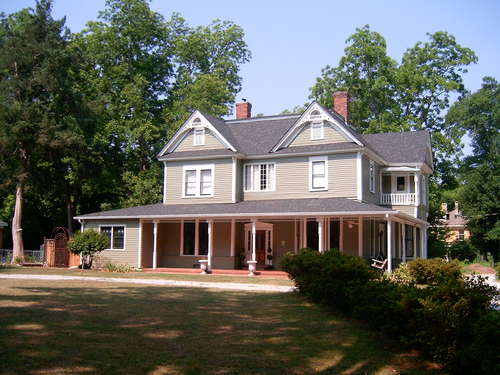 2 West Main St. in historic downtown Hampton and within walking distance of the proposed Hampton Commuter Rail Station is an outstanding residential and/or business opportunity.
Less than two miles away it's "life in the fast lane" with the Atlanta Motor Speedway and it's $1,000,000+ trackside condominums. At the other end of the street 2 West Main is like a "walk down memory lane" with it's proximity to a walkable downtown and neighborhoods.
This circa 1892 victorian grande dame has been lovingly renovated with new carpet, drywall, windows, paint, roof and French country kitchen.
The home falls within Hampton's "Bed & Breakfast district" and has excellent potential with it's 11 rooms, including 6 bedrooms, a second kitchen, sunroom, and two reception rooms (the home was recently renovated for wedding receptions).
The home is adjacent to the Hampton Downtown Streetscape Enhancement Zone with $500K of improvements coming out the front door.
For 24 hr. recorded info on the home call 800.523.1606, ext. 2.
Tuesday, November 14, 2006
Closed Ford Plant could be Transit Town of the future
It's interesting how things cycle around. With two icons of American transportation faultering or failed on Atlanta's Southside (Delta and Ford), it could be rail that helps bring desperately needed economic recovery.
The Ford Motor Plant closing has removed the primary sticking point between Norfolk Southern and GDOT. With the plant shutdown, the eight million dollar track upgrades NS had previously stipulated are no longer necessary, freeing the long-stalled Atlanta - Lovejoy Commuter Rail Project for passenger traffic within two years (DOT Board Chairman Mike Evans says Commuter Rail is "full steam ahead").
The national trend shows six dollars of redevelopment investment for every one dollar of rail investment.
This makes the Ford Plant, with it's position between the rail and downtown Hapeville, ripe for transformation into a Transit-Oriented, Mixed-Use Development.
The Ford Motor Plant closing has removed the primary sticking point between Norfolk Southern and GDOT. With the plant shutdown, the eight million dollar track upgrades NS had previously stipulated are no longer necessary, freeing the long-stalled Atlanta - Lovejoy Commuter Rail Project for passenger traffic within two years (DOT Board Chairman Mike Evans says Commuter Rail is "full steam ahead").
The national trend shows six dollars of redevelopment investment for every one dollar of rail investment.
This makes the Ford Plant, with it's position between the rail and downtown Hapeville, ripe for transformation into a Transit-Oriented, Mixed-Use Development.
Saturday, November 04, 2006
Greenways...borrow the power in our minds of the River, the Forest, and the Journey
Greenways are popular now for some very good and lasting reasons. They
remind us that our urban environment is not just a fume-choked freeway or
boulevard of billboards.
We may go out of our way to despise the city rather than see it as our own habitat, however unnatural. Here we work, consume, sleep—but we also grow, play, and learn. Few of us live near the rainforests or Arctic wilderness that attract so much environmental attention. We experience our lives as urban people—by the year 2000, over 80% of Americans will live in cities or suburban areas. And yet there is wildness,if not Wilderness by bureaucratic designation, in our urban areas.
As conservationists, greenways, as places where the natural world lives in the midst of cities, deserve more of our attention. Most of us have an image of a greenway as a river plus a trail. Those are the typical ingredients in greenway systems—some as large and complex as the Hudson River, others as small as the nameless creek through a townhouse project. Other greenway corridors include road and utility rights-of-way, abandoned rail lines, drainageways and canals.
All these combine the natural with the industrial, provide recreation and wildlife habitat, and link utilities and living streams. In short, greenways are linear parks that borrow the power in our minds of the River, the Forest, and the Journey.
The importance of greenways lies in this diversity. While greenways provide
some very tangible benefits to the urban world, they also make appealing
environmental projects....
—STUART MACDONALD, (Colorado State Trails Coordinator), Greenways: Preserving our Urban Environment, Trilogy, 1991
remind us that our urban environment is not just a fume-choked freeway or
boulevard of billboards.
We may go out of our way to despise the city rather than see it as our own habitat, however unnatural. Here we work, consume, sleep—but we also grow, play, and learn. Few of us live near the rainforests or Arctic wilderness that attract so much environmental attention. We experience our lives as urban people—by the year 2000, over 80% of Americans will live in cities or suburban areas. And yet there is wildness,if not Wilderness by bureaucratic designation, in our urban areas.
As conservationists, greenways, as places where the natural world lives in the midst of cities, deserve more of our attention. Most of us have an image of a greenway as a river plus a trail. Those are the typical ingredients in greenway systems—some as large and complex as the Hudson River, others as small as the nameless creek through a townhouse project. Other greenway corridors include road and utility rights-of-way, abandoned rail lines, drainageways and canals.
All these combine the natural with the industrial, provide recreation and wildlife habitat, and link utilities and living streams. In short, greenways are linear parks that borrow the power in our minds of the River, the Forest, and the Journey.
The importance of greenways lies in this diversity. While greenways provide
some very tangible benefits to the urban world, they also make appealing
environmental projects....
—STUART MACDONALD, (Colorado State Trails Coordinator), Greenways: Preserving our Urban Environment, Trilogy, 1991
Friday, November 03, 2006
Thursday, November 02, 2006
Peachtree Corridor
The Peachtree Corridor Task Force has launched its new Web site. To visit the site, click here or type www.peachtreecorridor.com into your Internet browser.
Formed by Mayor Shirley Franklin in November 2005, the Peachtree Corridor Task Force is charged with developing strategic recommendations to transform the Peachtree Corridor into a foremost destination for Atlanta's visitors and residents. The goal of the task force is to create one grand boulevard linking together the city's diverse but complementary business, entertainment, cultural and residential centers.
The spine of this corridor will be a steetcar system.
Formed by Mayor Shirley Franklin in November 2005, the Peachtree Corridor Task Force is charged with developing strategic recommendations to transform the Peachtree Corridor into a foremost destination for Atlanta's visitors and residents. The goal of the task force is to create one grand boulevard linking together the city's diverse but complementary business, entertainment, cultural and residential centers.
The spine of this corridor will be a steetcar system.
Sunday, October 29, 2006
Bikes + Transit
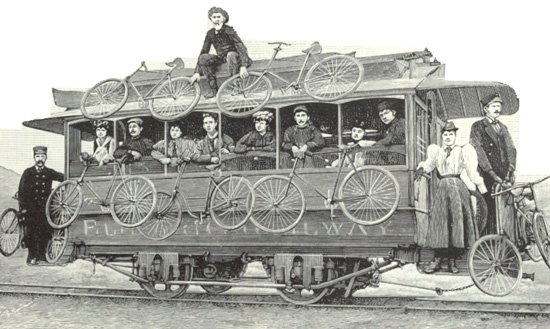
Bikes are not as practical for long distance trips (although the definition of "long distance" changes once you switch from driving to cycling as your main transportation mode). In these cases it makes sense to have a good public transit system.
The good news is that with all the available room left by today's car infrastructure, we would have plenty of space to create dedicated transit lines through the city so that bicycles and buses or trolley cars can coexist safely and peacefully. Since their range and uses are distinct, transit and bikes compliment each other whereas transit and cars currently compete for space and for users.
The integration of bicyles and long-distance transit are even more compelling. Today, many commuters complain that train service is expensive and infrequent, but trains could partner with bicycles to their mutual benefit.
The catchment area for a bicycle-oriented train station would increase dramatically over mere pedestrian access. The station would no longer require a huge parking lot to accomodate commuters arriving by car, since bicycles take up so much less room. Each station could run very productively and frequently, with trains at frequent intervals.
Source: "Can the Bicycle Save Civilization?" by Ryan McGreal
Friday, October 27, 2006
DMU + Biodiesel
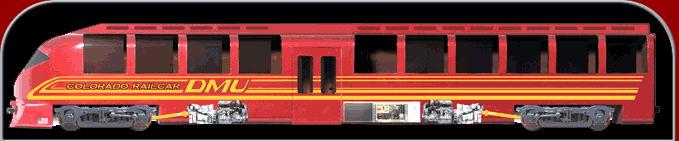
Portland, Oregon has announced a new commuter rail line between Wilsonville and Beaverton. When completed, the 15-mile-long line will serve one of Oregon's busiest commuter corridors. It will not be light rail, as in the MAX system that serves much of the greater Portland area. Instead, the new commuter rail line will use existing freight train tracks. The tracks will carry DMU's, quite popular in Europe for some time. These Colorado-built rail cars are self-propelled and are about 6 times more fuel-efficient than traditional commuter engines. One of the real benefits is that they are legal on freight lines without upgrades, saving potentially millions on infrastructure improvements.
The applicability of this technology to the metro Atlanta area cannot be overstated, with the city once know as Terminus sporting extensive "spoke rails" in all directions. DMUs could be deployed on these rails in the short term.
Add the potential of using biodiesel to power the railcars (currently being tested in Minnesota) and you've got a powerful blended solution for addressing Atlanta's transportation and environmental woes.
Tuesday, October 24, 2006
How Cuba survived peak oil
People will be doing a lot more bicycling and carpooling. Even hitchhiking could become socially acceptable. Cuba went through an energy famine in the 1990s, and traffic cops there halted cars with empty seats and made them wait for hitchhikers. Cubans also created more urban gardens, produced more of their own food, and made more public-transportation options available.
~ from "An Interview with Richard Heinberg", The Sun
~ from "An Interview with Richard Heinberg", The Sun
Flexcar comes to Atlanta
Liz Wattenberg, General Manager of Flexcar - Atlanta, informed me today that I had the highest bid in a silent auction for Flexcar rentals. So I signed up today online.
Flexcar is a great development for Atlantans seeking to reduce their reliance on the automobile. Urban trend-setters in other cities have begun giving up their second car, or cars altogether, when they have discovered Flexcar. It makes transit-oriented living even more viable as you can now have access to a car as-needed with this innovative car-sharing solution.
Location-efficient mortgages, like those provided by my friend Jeff Cole of myEnergyLoan, factor the reduction of automobile expenses into the qualification equation, opening up the realm of possibilities for Buyers seeking to make Intown living financially feasible.
Now Flexcar has partnered with Novare Developments in Midtown and Downtown to offer residents of Spire, Metropolis, TWELVE, or Biltmore House special incentives and onsite vehicles. Check it out here.
I would consider it a privilege to serve as your Buyer's Agent in the purchase of these homes and could offer the Rail Estate Rebate for these purchases like we do other transit-oriented real estate.
Flexcar is a great development for Atlantans seeking to reduce their reliance on the automobile. Urban trend-setters in other cities have begun giving up their second car, or cars altogether, when they have discovered Flexcar. It makes transit-oriented living even more viable as you can now have access to a car as-needed with this innovative car-sharing solution.
Location-efficient mortgages, like those provided by my friend Jeff Cole of myEnergyLoan, factor the reduction of automobile expenses into the qualification equation, opening up the realm of possibilities for Buyers seeking to make Intown living financially feasible.
Now Flexcar has partnered with Novare Developments in Midtown and Downtown to offer residents of Spire, Metropolis, TWELVE, or Biltmore House special incentives and onsite vehicles. Check it out here.
I would consider it a privilege to serve as your Buyer's Agent in the purchase of these homes and could offer the Rail Estate Rebate for these purchases like we do other transit-oriented real estate.
Sunday, October 22, 2006
Xebra EV is a great intown solution
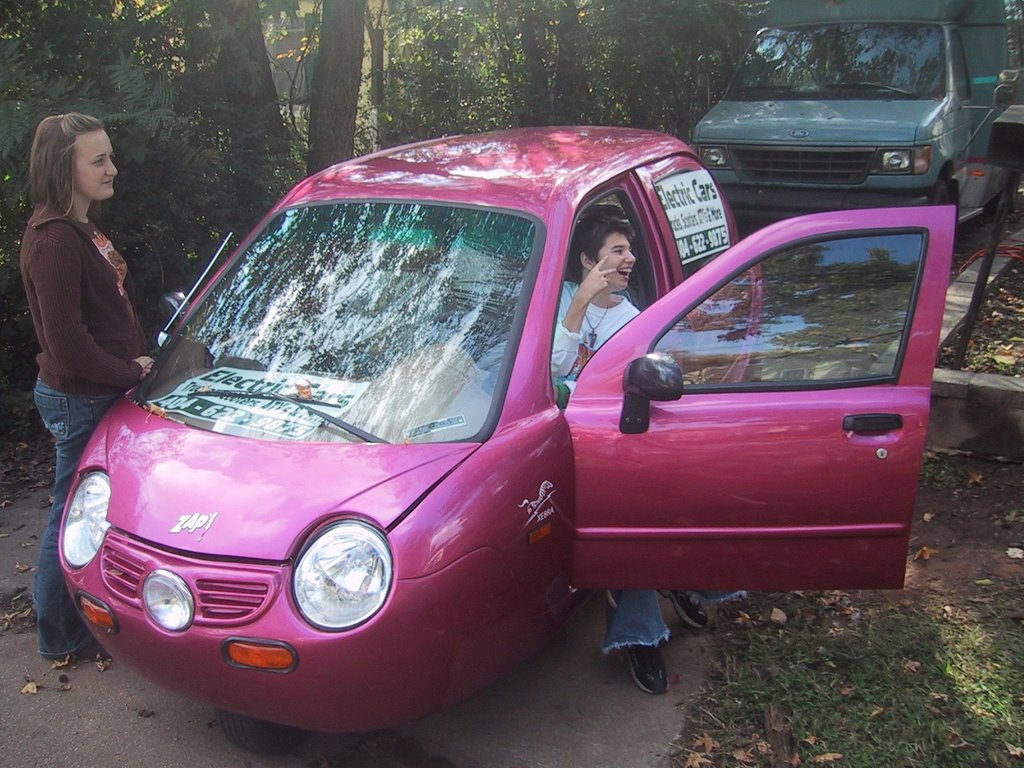 A company called Green Planet is opening a ZAP EV dealership in Atlanta. The family and I test drove the Xebra last weekend (that's my daughters Shelly and April in and around the vehicle pictured). This three-wheeled vehicle is the first Chinese production vehicle to be sold in America and is the only city-class EV that you can actually purchase right now. The Xebra is different from it's predecessors, including the ill-fated GM EV-1, in that it charges with a standard 110v plug. You'll recall that in the late 90's when electric vehicles were in use for a minute, they required special charging stations to hook up to. Not so with the Xebra. Any accessible standard wall outlet is a potential charging station powering this little vehicle at a cost of three cents a mile.
The Xebra is an alternative niche product that is another weapon in the fight against traffic congestion, foreign oil dependence, and climate change.
Subscribe to:
Posts (Atom)